Archive - The Journey RSS Feed

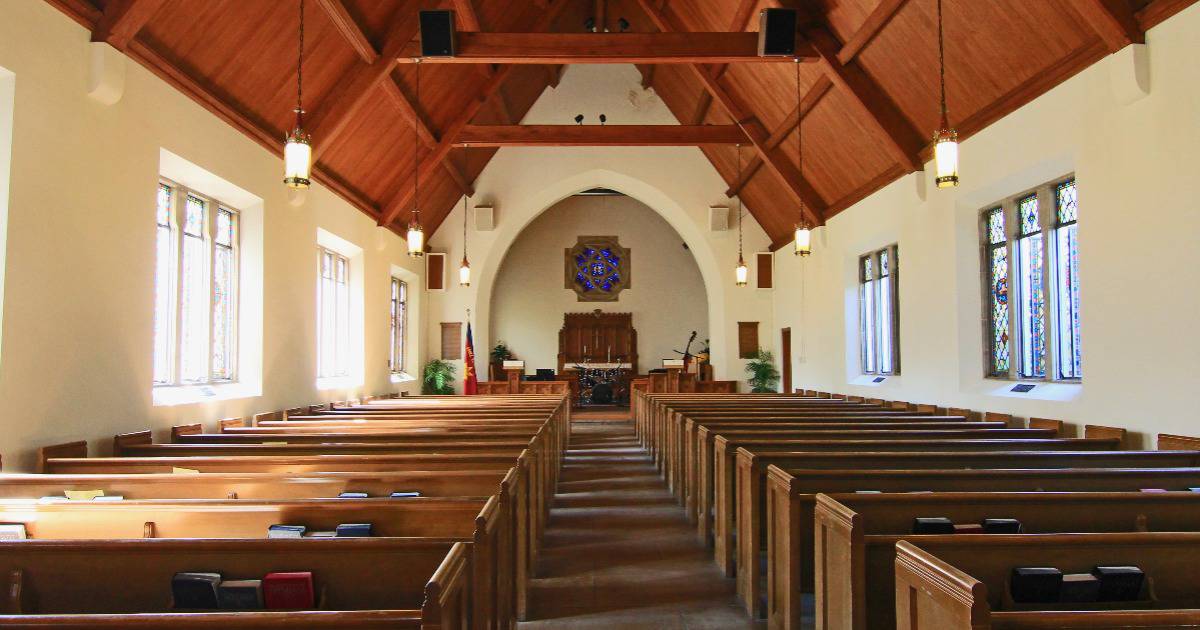
Would Jesus Go to Chapel?

asleep-in-chapel

Weekly chapel is an exciting rite of passage in the first weeks of seminary.  I can still remember many sermons where a pastor would talk about his own chapel experiences way back in the day.  This past year it was my turn.  My wife even came to the first couple of chapel services too.  I have to admit: the novelty wore off by the third or fourth chapel.

The first time I didn’t go to chapel I thought I had a pretty good excuse.  I missed my quiet time with the Lord that morning at home.  I was tired from not sleeping well the night before and my brain was already full from two hours of mind-boggling new information in hermeneutics class.

I was surprised to learn that I was not alone.  I walked around the campus feeling like I’d stumbled into a secret club.  Here and there, students were dotted around the campus.  I thought I’d missed the rapture—and I’m an amillenielist! Other guys and gals were talking on their cell phones, typing away on their laptops, or just clustered around a table in the corner of the student center talking sports…or Greek (and then back to sports).  When I asked one guy about why he didn’t go to chapel he shrugged his shoulders, “It’s an hour to get stuff done.”  By the next week, when I had an assignment due that afternoon, I found out he was right.

OK, forget me, forget the other student.  Forget even yourself.  What about Jesus?  He is our example for all things, but what about for attending chapel?

Think about the Lord’s experience growing up in Palestine.  In coming to fulfill the Law and being Himself a model Jew, Jesus would have certainly attended synagogue every Sabbath and journey to Jerusalem at set times.  Judging from what He had to argue against during His public ministry, I can’t imagine what He sat through before then.

Imagine Him sitting quietly, listening to Pharisees placing legalistic burdens on their hearers.  How He must’ve wanted to shake His head at the misguided Sadducees denying the resurrection.  How many eloquent-but-meaningless musings from the scribes, did He endure?  Sure, there had to be times where He thought joyfully to Himself, “This one is not far from the kingdom!”  But those moments were rare, unlike the religious hypocrisy of many teachers on display in the public places during the week.  How many trips did He make to Jerusalem, where He would see and hear all of these things on a grand scale?  It’s enough to make one never go again…

…but not Jesus.

Scripture gives no indication that He ever questioned/debated/argued with the religious leaders of His day before His public ministry began.  To do so before His appointed time would have been disrespectful.  It would have been dishonoring to His Father.  No, Jesus came “to fulfill all righteousness” (Matt. 3:15).  He did “all things well” (Mark 7:37).  In fact, for these same reasons, not only did He attend services, He would have paid careful attention too.  (As hard as this is for me to write–knowing my own shortcoming in this area—if He was a student today He also would not be surfing the internet during class lectures.)

Jesus, then, would go to chapel.

As I thought all of this through, when I came to the conclusion that Jesus would go to chapel (and pay attention in lectures) I was convicted.  I started going to chapel again.  Honestly, it is not always edifying.  Sometimes I don’t know the songs, sometimes the sermon is academic, maybe, but not inspired.  Other times I am simply pre-occupied with thoughts about what I just learned that morning, upcoming papers, or how I am going to pay for next semester.  But I go because I want to be obedient to the Lord.  He brought me here to seminary in the first place.  He also was obedient and faithful in far more than just going to mid-week chapel.  Do I not owe Him at least that?

What about you?  Will the Lord see you in chapel this week?

Without Jesus… Nothing.

Nativity

It has been four months since we began this journey to and through seminary together. Thank you to those who have read, commented, encouraged and helped me along the way. There is one resounding question in my mind that continually drives me to my knees, keeps my wife understanding and gives me hope in my studies. Why? Why am I here? Why did we move to Dallas? Why did we leave behind career paths, friends, family, opportunities and comfort that God had blessed us with? The answer is Jesus. And there is no greater question or answer to reflect upon this week.

I am writing this prior to finals in hopes to have it submitted early, but it should appear six days before the day we have designated to celebrate the birth of our Messiah. Jesus did not have a Christmas tree, gifts, red wrapping paper, a stocking over the fireplace or snow on the ground when he was born. All these things have been used by our culture to symbolize this time of year. As long as we continue to see this holiday as a celebration of the birth of Jesus Christ, His coming to humanity in its state of sin to bring us freedom, to bring us salvation, to bring us to Himself, then I think any item that drives us to remember what Jesus has done, can be good, whether it is red wrapping paper, a Christmas tree or lights displayed on trees, homes and stores.
I hope that as you study theology, Greek, Bible study methods, and read through those big books the seminary required you to buy, you will remember that it truly does all come back to a child, laid in a manager, 2,000 years ago. I love the Old Testament because it points me to Jesus. I love the New Testament, because it points me to Jesus. In all of our intellectual pursuits, whether seminary, a Bible study, a meeting with a mentor or a personal pursuit of holiness, we must remember to “fix our eyes upon Jesus, the Author and perfector of our faith” – Hebrews 12:1-2.

I hope this semester has been a blessing for you as much as it has been for me. Whether you are making copies and pizza, realizing the Honeymoon is over, finding out that God’s ways are not the same as yours, or just surfing the web for new blogs, I hope you remember Jesus. I hope you ask yourself, “Why?” Why are you doing what you are doing? Why are you where you are? Why are you doing the things you are doing and making the choices you are making? Are you pursuing Jesus in those choices, or a Master’s Degree to hang on the wall?
The temptation is always there for me to think of that degree. The temptation is there to think of a DTS class ring, walking across that stage at graduation, and having another, “I accomplished something” moment. As I have read through John 15, Colossians 3 and Ephesians 1 recently, I have come to realize that I truly can do and have “nothing” apart from Christ.

At least for now I have a built in way to keep my eyes fixed on Jesus and be reminded of what He has done for me daily. As long as there is snow on the ground, stockings over the fireplace, red wrapping paper and a tree in the corner of a home, we are reminded and made consciously aware that Jesus came, gave His life and rose from the dead 2,000 years ago to set us free today. Merry Christmas. I hope the subtle differences you see throughout your day this time of year remind you of the first Christmas and drives you to long for the only one that will top it – our first Christmas in eternity when we spend it with Jesus in Heaven.

Seize the Blessing

Greek-Gospel

In my mind, the primary reason we attend seminary is so that we can learn how to handle God’s Word appropriately. Of course there are many other benefits to seminary that go beyond that, but I believe that this is what makes seminary unique. There are lots of places to learn some of the more “practical” things, but ultimately it gets down to God’s Word.

To do that most seminaries will force you to learn the original languages. There are many good reasons to do this. Luther wrote “let us zealously hold on to the languages” in one great article. Erasmus described reading from the Latin Vulgate as “drinking from a muddy puddle” while reading the New Testament in Greek was like drinking from a “pure fountain.” Of course, most of us give mental assent to the truths of this, but the fact is that we have some very good English translations and if we use them properly we can get to the same place, right?

After all, Greek and Hebrew are a lot of work. It takes a lot of time to study paradigms. It is exhausting to translate even a familiar passage of Scripture as we go through our grammars and lexicons for reference. Despite the best efforts of Bill Mounce, there really is no fun way to learn vocabulary. All these things just take mental elbow grease.

What I’ve noticed is that most students get through the languages and then pretty much discard them. They gave lip-service to the value in learning them, but clearly they did not see the point. If they had they would have stuck with them.

My exhortation to you is to keep up with your languages. Like with physical fitness it is much easier to maintain than to get it back once you’ve lost it. There are very good reader’s editions of Greek and Hebrew that will get you past the drudgery of obscure vocabulary and keep you in the text. Commit to spending a little bit of time each day. Even 5-10 minutes will do if that is all you have.
I have a few personal motivations to do this. One is that I worked very hard in Greek and Hebrew classes and I don’t want to just throw all that time away. I have talked to countless men in ministry who remembered taking Greek and Hebrew, but cannot use any of it today. I don’t want to be one of those guys.

Another is that I see the value in it. I would not go so far as to say that it is vital to keep up with the languages, but it is definitely very valuable. As a practical matter, diagramming a passage from Paul often gives you the points of your sermon right from the text. Remembering how the languages work will sometimes help you make decisions about the meaning of difficult passages too. Some things just don’t translate perfectly into English.

But for me, perhaps one of the most compelling reasons is to recognize just how blessed I am. There are pastors around the world who don’t even have a Bible, let alone a seminary education. They would love to have just a complete Bible in their native language, let alone one of the many excellent study Bibles that are available to me today. We have a plethora of resources at our fingertips. Our seminary educations give us outstanding preparation for ministry. Throwing such a key part of that education away is akin to the millionaire who lights his cigars with $100 bills. Why waste something so valuable?

According to my Plans?

GPS

Have you ever taken a trip? Did it go just like you had planned?

Chances are, if you’ve traveled much at all, at some point you’ve found yourself dealing with unexpected delays, detail changes or maybe even a complete cancellation of your plans.

For those of us in ministry we often joke about schedules and plans and how they never work out as you expect. I believe in schedules, I believe in plans. Last night my wife and I were discussing this topic, and I am convinced that we must plan and prepare more than I thought was necessary as a younger man in ministry.

I recognize that our plans are not something to be set in stone with no opportunity for deviation, but rather a guided structure that bring us back on track when the unexpected occurs.

Very rarely do we plan a trip and have everything go exactly as we expected. The challenge with planning a trip with others or doing ministry and life with others is that “others” are involved. Pre-conceived plans, notions, ideas, rabbit trails and thoughts are quickly thrown to the side once someone presents a perspective or plan that you and I never thought of. I think it is a blessing to be able to stop where you are, acknowledge and accept a better plan and proceed down that path.

God gives us the responsibilities to pray, plan and proceed. Then He accomplishes His purposes through us, even when we think nothing is going “as planned.” I am pretty sure Joseph did not plan on spending time in Egypt as a slave prior to becoming second- in-command over Egypt. I am pretty sure Moses did not wake up one day and plan to kill an Egyptian, live in the desert for 40 years, hear God speak to him and then lead an entire nation to freedom in Yahweh’s name. It can be a very good when things do not go according to our plans.

Seminary is not an “according to my plans” time. I’ve spoken with several other students and we all have experienced this dry, the-sap-of-life-is-being-sucked-out-of-me feeling around the second or third month of the semester.

I think we have figured out what it is. For some reason, although I and others have spent years trying to spend daily time, communing with God, asking for guidance and digging into His Word in the desire to have our lives, thoughts and actions shaped by it, we came to seminary and seemed to forget what is important in our personal lives, relationships and specifically, in our relationship with God. Around October I began to wonder why I was so stressed, where my peace had gone, and why I didn’t feel connected to God.

I guess prayer, accountability and personal reflection have something to do with that. I and many classmates traded those things for more study time, more reading and Greek vocab cards.

I hope you are reading this thinking, “this guy is an idiot.” Good! Don’t do what I did. Maybe you are reading this and it is hitting home with you, like it has with so many students I have spoken to over the last month. That is OK, too.

Many other students I spoke with said they, like me, came here and for the first time in years were just students – not the guy leading a Bible study, youth group or ministry. Between not setting aside a quiet time for reflection and not being as active the Church body as we had been for years, we began to feel like the most pious, spiritually numb people in the world.

Seminary is tough. Life is tough. If your seminary experience is pushing you away from God, something needs to change. And here’s a hint – it’s not God; it is always us.

I do not know exactly what this looks like, but I can tell you that we are not alone. Most of the students I have asked either have struggled with this, are struggling with it, or even face it every semester. This is my first semester. I would love to get the answer right the first time, but that rarely happens for me.

I met a student last Sunday who gave me a word that summarized all this, reflection. He told me his struggle had been to reflect upon what he was learning each semester. Once he recognized it and reflected upon how this new understanding should change the way he lived, he was able to apply the lessons to his life and grow in his personal relationship with God. He graduates in May. I am sure he has a better answer than I do. Please leave comments, suggestions, advice, verses and prayer requests.

Welcome to the Journey. It’s ok if you forgot something, do not finish in the time you planned, are led into youth ministry when you wanted to be a lead pastor or go on to be successful in business. The important thing is that when you leave you learn to love God and serve others more than when you came.

Stop Smelling the Syllabus

class-binder

Life is full of surprises. A tired, cliché phrase, I know. But the phrase speaks the truth. With friends and family, we share stories that surprised us. We remember them vividly because the stories are pivotal in shaping our lives.

Seminary life, on the other hand, can become mechanical because of its lack of spontaneity. Conjugating a verb is a norm. Formatting a paper properly is a pain. Approaching a new syllabus with the attitude of “I came, I saw, I conquered” crumbles weeks later as we whimper at its overwhelming demand. On the paper are dates of reading assignments and paper deadlines. For the next couple of months, these dates govern our lives, and sometimes, we feel that the syllabus rules with an iron fist. Mercy is not its priority.

Meanwhile, it has another effect—life appears less surprising. Ever since I started seminary, life is defined by how much I can cross off the dates on the syllabus. Done that reading and now I’m ready for the next, I thought. Like Harold Crick, played by Will Ferrell, in the film “Stranger than Fiction,” my current life is based on the timing marked on the paper, except his was a wristwatch. What eventually colors his gray, mundane life is the moment he realizes how life has more to offer than just following the tick-tock.

Whenever I talk to seminary graduates or read about their experiences, they recount stories that take unexpected turns, whether getting financial aids in a time of need, creating friendships with people you wouldn’t expect, or reading a work you come to love when you wondered why a tree must die to become that book. They remember those surprising events that colored their seminary life.

One of the benefits a seminarian has is getting student discount to theology conferences. To enrich my seminary education, I attended the 2010 Wheaton Theology Conference, whereas the academic topic revolved around the works of its main speaker—N.T. Wright, a New Testament scholar and former Bishop of Durham in the Church of England. For two days, Wright gave several messages in a room of 1,100 people, a rather large crowd.

During a break, I chatted with a friend, who is deaf like me, and a Sign Language Interpreter, who was interpreting for the conference. While the audience was stretching their legs and meeting each other, a man approached us. He greeted and asked us if he was speaking too fast for an interpreter to catch his words. At first we were puzzled by his question when only a moment later we realized he was Wright himself. After we informed Wright that the interpreter was doing an excellent job, he smiled, expressed good wishes, and departed to the speaking platform to begin another message.

Dumbstruck we were.

I came to the conference to learn something about his works; however, I left the conference learning something about the man himself. Whenever I read his books now, I could not help but remember that simple event between the four people among 1, 100 people. That meeting became a story that has colored a fraction of my seminary life.

Another cliché phrase I hear is “stop and smell the roses.” Like the previous phrase, this is also true. Harold Crick stopped and smelled the roses. For him, the roses were having a girlfriend and learning to play a guitar. For seminarians, the roses come in various forms—playing with kids, visiting a nursing home, gardening, or even more odd, visiting graves of dead theologians. Seminary doesn’t have to be just crossing off dates on the syllabus; it offers more than that.

Use the syllabus to discipline yourself, but not to define your life.

The Honeymoon is Over

Teenager with puppy

Do you remember your first experience with puppy love? You fell in love with that cute girl/boy across the classroom, playground, grocery store, etc. Immediately, in your mind at least, this woman or man became your knight in shining armor or the princess locked in some high cold peak, awaiting you to come save them. Then they were gone, maybe you spoke to them, maybe you walked up, talked to them and dated them. I’m guessing at some point you realized they were not “exactly” what you had imagined. We tend to use the phrase in America that when you realize this, “the Honeymoon is Over”.

Welcome to your first month of Seminary. I fell in love with Dallas Theological Seminary 3 ½ years ago when I visited campus for the first time. I heard professors telling me that it was not about me, the knowledge you get or do not get, but learning to love God and others more with every tool (like seminary) that God provides. I was hooked. Surely, I assumed, everyone who applies gets accepted here, (note the 3 ½ year span of waiting), surely all the teachers grade on a curve, give you lots of Grace and everyone agrees on each Theological point presented.

Wow, is the Honeymoon ever over. After one month of classes, especially Greek, I seem to remember how difficult Spanish was in High School. After one month of sitting next to students from every corner of the world I am beginning to see how culture affects my perspective on things. After one month of sitting under amazing men and women who open God’s word and see things I never knew were there I am beginning to understand that maybe we do not have all the answers at the beginning, middle (after seminary) or end of our lives.

Everyone finds different things in the same passage. We observe differently, we perceive differently and the Truth of God’s Word affects each of our lives individually and very differently from the person right next to me.

It is almost like God wrote this Love letter (the Bible) just to me! Please note, I am not insisting that we take the Bible out of context and see whatever we can make out of a few words. I am saying that reading Philemon and understanding a slave being freed means something much different to me, a Caucasian Midwestern than my friends from Korea, China, and South Africa who sit next to me and internalize those truths in a different way.
It is a wonderful thing to be part of a multi-cultural community that is seeking the same goal of being accurate to God’s Word, Loving Jesus Christ and pursuing Him with their lives. I am discovering things I would not have known sitting at my desk at home with a Bible, concordance and some commentaries.

As much joy as I am getting from the classes, professors, students and projects, the honeymoon is over. I have roughly 400 pages of reading each week, Greek to study every day, large projects due each week, month, and a big one due at the end of the semester. At this writing a month has slipped right past me as a breeze through an open door and I am realizing the chill. A month is gone. That big project is due in two more. My Seminary career will be done in a brief moment of time.

Congratulations to all who make it past the honeymoon. Things are not easy here. Since coming to Seminary I have heard more stories of personal, financial and emotional tragedy than I have anywhere else in life. The story of “my car broke down at the state line” is common. The story of “I could not pay rent, then a check showed up,” is heard often. It is amazing to see how God provides.

As with puppy love, sometimes things do not develop how we thought they would. On a very sad note, my classes are much smaller than they were five weeks ago. Many have decided that either Greek or seminary all together was not for them. God leads us all down different paths in lives and I know that he can use each of us in His way and time. Seminary is not for everyone. But to those who made it through the first month, the first five weeks, the first semester, congratulations. Whether you are still dating, or in a committed marriage relationship to this thing called Seminary. Stay the course. God Provides and we will make it through this with His help.

Serving Pizza and Making Copies

Serving Pizza

Desire… Have you ever had a desire for something deeper than yourself? Of course, as a Christian, we all have.  Has that desire been so strong and so internally compelling that it scared you?  Has a desire like this driven you to pursue God in a way that looks very strange to those around you?  Do you get up early to read about God and spend time with Him?  Do you pick up strange and difficult books to grasp a glimpse into the eternal being that created you?  Do you long to know more about Psalm 139 and look at biology through a lens of “how God knit me together?”  If you have a desire that has gone deep within you and touched every aspect of your life and the way you see the world.  That is a start.

Commitment… Have you thought about being in ministry full time?  Many of us dream of a job where we can read, hang out with Jr. High Kids, Counsel or Study all day.  Have you feared it yet? Have you come to a point of rationalization where you have to ask, “Can I handle it?”  Have you thought through constant interruptions, counseling mothers and fathers whose children have just committed suicide, being there for men and women as their marriages, careers, lives and families fall apart?  Have you been afraid of it yet?  If so, that is a start.

Compassion… How has your heart changed over the last few years? Not last week for that cute girl who won’t call you back, or last month for that rock band you loved, or last semester after the retreat on Evangelism you went to, over the last few years?  Are you more excited to reach the lost because they need Jesus or because you have a new comeback or apologetic to try out?  Is your heart driven to love the lost because you remember how you were a hopeless slave to sin, living apart from God, Lost and with No Hope in this world? (Eph 2:12).  If you were saved a young age, do you know what your heart is for the lost?  Have you found that yet?  Paul said he was in the pains of child birth, Gal 4:19, until Christ was formed in these Galatians who already knew salvation but were not growing.  Have you gained compassion for the lost and those in need of growth as you look at your own sin and struggle with the flesh?  Do you long to come along side your brother or sister in Christ, do battle with them, go through the pain of failure just to reap a moment of victory and pray for God to give growth to that person?  If you long for that, it is a start.

Pride… Have you left yourself behind?  If you can do anything outside of ministry, go do it. You do not belong in Seminary.  Seminary can only mold and shape you to have a more effective ministry.  Perhaps that ministry is serving burgers and witnessing to others, if that is your passion, jump on board, join the group, but if you can serve burgers and never care about the customers souls, Seminary is not for you.

Change… Everything above was my journey to Seminary.  It has been a 15 year process of prayer, research, God giving the growth as other servants planted and watered the seeds of God’s Truth into me, growing a compassion for the lost to a point of knowing that I could never not be in ministry.  Pray, be patient and Trust God.  If He wants you in Seminary, you will get there.  And if not, you will be blessed with whatever ministry he has laid before you, even if that is ministering to the customers at your local hamburger shack.

Remember… Full time ministers do not often get to work at gas stations, bus stops, restaurants or offices.  God still ministers there. We are part of a body of believers.  If you are a hand, be a hand.  If you are a foot, be a foot.  If you are a member of the body of Christ, keep your eyes fixed on the Head, Jesus and serve where you are today.  Seminary may be in your path.  I embraced the growth He gave me when I was serving pizza, making copies, meeting with college kids, sitting in an office and serving in the local Church while praying about if Seminary was for me.

Rebuilt Houses

brick

I started seminary as a 32 year-old who experienced some serious personal trials. By the grace of God I had been set free from both pornography and self-gratification as well as gluttony and laziness. I had served in a ministry helping men find freedom from those habitual sins and in that time developed what
I thought to be a pretty sound theology. I figured that I needed seminary to give me a piece of paper so that I could get hired by a church to do full-time ministry.

While it is true that a MDiv does open doors, I have since learned that seminary is about much more than the piece of paper. To be perfectly honest, I wanted my school to bless my convictions so that I could move on to the “real” work. I had no idea what I was actually getting into. Here I thought I was simply attending a school that pretty closely matched what I already believed and, therefore, I would
not be challenged too much. I was very wrong.

The first big challenge came when I took an elective course on 1 Corinthians. We had to write papers describing all the views we could find on some of the more controversial passages. What I learned was that there are a LOT of views out there and quite a few of them have biblical warrant even within a traditional approach to inerrancy and inspiration. I suddenly realized that there was not quite as much room to be dogmatic about some issues as I thought.

Next came Greek exegesis. That was where I learned about textual criticism. I have not gone down the road of some folks like Bart Ehrman, but it did make me rethink my view of the text. I still believe that the Bible is God’s Word and we can trust it, but looking at the text-critical issues around some passages definitely opened my eyes to what goes on under the hood of our English translations. This served to leash my dogma.

Another big challenge was my hermeneutics class. I came from a nominally Roman Catholic background, but am a fully-committed Protestant now. However, hermeneutics made me appreciate the authority of the Roman Catholic Church because I began to see how easily the Protestant system can devolve into “what this passage means to me.” This showed me how important it is to be tethered to church history because if you see something in a passage no one else has seen for nearly two millennia you’re probably on the wrong track. And even if you do find precedence in church history you may still be on the wrong track. This forced me to relax my dogmatic approach on some controversial passages where I previously thought that disagreement with me meant you were a heretic.

Finally, my Hebrew classes really opened up my eyes to how we translate and read the Old Testament. The wide semantic range of many Hebrew words has taught me to be careful about making too much out of any single translated word in my English Bible. This was yet another thing to soften my previously hard dogmatic approach. Just as anyone preaching from the New Testament should promise not to overstate the aorist tense, I learned not to overstate the value of Old Testament word studies.

I write this story to encourage anyone in seminary to engage your classes with an open mind. You are learning from men and women who have dedicated their lives to particular subjects. Chances are they have thought through these issues more deeply than you have or will. Do not simply seek approval for what you already believe when you enter seminary, but allow the experience to transform you.

Personally, I feel like I have acquired a framework for thinking things through. I may not always come to the same conclusions as my professors, but at least I have a way to evaluate these issues and make my own decisions. And I have the freedom to do that as well, as long as I have biblical warrant to do so.

Basically, I am grateful to have opportunities to tear down some personal theological houses of straw and rebuild them with brick. The rebuilt houses may have the same shape as those of straw, but they are now much more solid because I feel more sure about the Rock on which they are built. And that is easily the greatest blessing I received from seminary.

I Keep My Eyes Open During Prayer

eyes_open_prayer

On my first day of class, my professor began class with a prayer. While students closed their eyes, listening to the professor’s plea for wisdom in our studies, my eyes remained wide open. Was it because that pile of new textbooks near me screamed, “Look how beautiful we are. Read us.” No, although it was tempting. I looked elsewhere for a more important reason—the moving hands of the person sitting across from me. I listened to the prayer not with my ears, but through my eyes.

I am deaf. Opposite from me was an American Sign Language (ASL) interpreter.

Being deaf at a seminary brings unique challenges to overcome. The first challenge was to select a seminary. I based my decision to enroll by what the seminary had to offer; such as the school’s orbit of influence, prestigious faculty, and tuition fees. Yet I had a question that separated me from hearing prospective students. Could the seminary provide an interpreter? The added concern all deaf seminarians must consider.

There were several seminaries I could choose from. The first three were well known, the fourth was the seminary of my undergraduate alma mater, and the fifth was small.

Since the first three were endowed with large grants, the issue of hiring professional, certified interpreters was not a question. The fourth, with its tight budget, could only provide student interpreters, the same policy in place as my undergraduate years. Those interpreters learned ASL informally, such as in a high school foreign language requirement or through a deaf friend/parent. At one time, I met a student who learned American Sign Language through Sesame Street and books. Imagine how would he interpret a simple subject like, “Can you find a pink polka-dot van?” to a complex subject such as, “Discuss Van Til’s usage of the Trinity as a philosophical answer to his metaphysical question.” A seminary lecture would be filtered through the mind of an interpreter with preschool-level sign language skills. I marked off this seminary.

In a twist, I enrolled at the last choice, the one who could not afford to provide an interpreter. However, the reasons for my interest in this school were its small size and faculty’s emphasis of interdisciplinary learning. Typically, a student craves a personal relationship with his professor, and at this school, I was sure to get just that.

Ask any college student about his relationship with professors, and you will likely get an answer like this, “The teacher was stimulating, fun, and nice.” But it is usually nothing more than that. Often a student gets a teacher for no more than one or two courses, which breeds surface relationship between the two.

The first three choices have a huge student population and are research-orientated, so professors have very little time to understand the unique situation of bringing the gospel to the deaf population and its culture. The seminary in which I enrolled has several professors in residence, enabling me to have a professor for more than one or two courses. Sitting under him for hundreds of hours, I could learn about his strengths and weaknesses, listening to stories of life, family, and ministry. In turn, the professor learns how to interact with a deaf person, deaf culture, and the deaf ministry. A relationship is built.

So how did I function without an interpreter? I didn’t. Unlike many deaf seminarians, I am blessed with a hearing wife who could interpret well. For unusual words or theological concepts, we flesh it out and make up for non-existent signs. For ancient language courses, to pronounce Greek and Hebrew terms correctly was unfeasible. But I am not alone, hearing students struggle as well to pronounce the Greek, Hebrew, and the names of Dutch and German theologians. The positive side of being deaf is that I don’t have a professor laughing and poking fun at my wrong pronunciation. For this I am not too sorry for my hearing friends who are cursed with a capacity to hear clearly, yet speak unclearly. May God help them more than me.

Winners of the Kindle Contest

writers

We are a bit late posting our winners. Our deepest apologies for the delay.

Thanks to all who entered. We pray for your seminary journey to be one of great transformation.

We’ll post the first article on Monday, September 6.

And, the winners are:

I Keep My Eyes Open During Prayer – Nick Ng
Rebuilt Houses – Jason Chamberlain
Serving Pizza and Making Copies – Seth Ross
What They Don’t Tell You On The Walking Tour – Anthony Russo
Page 1 of 1212345...10...Last »